FIELD NOTE / N15
Agency vs In-House AI Marketing: Costs, Control & Capability
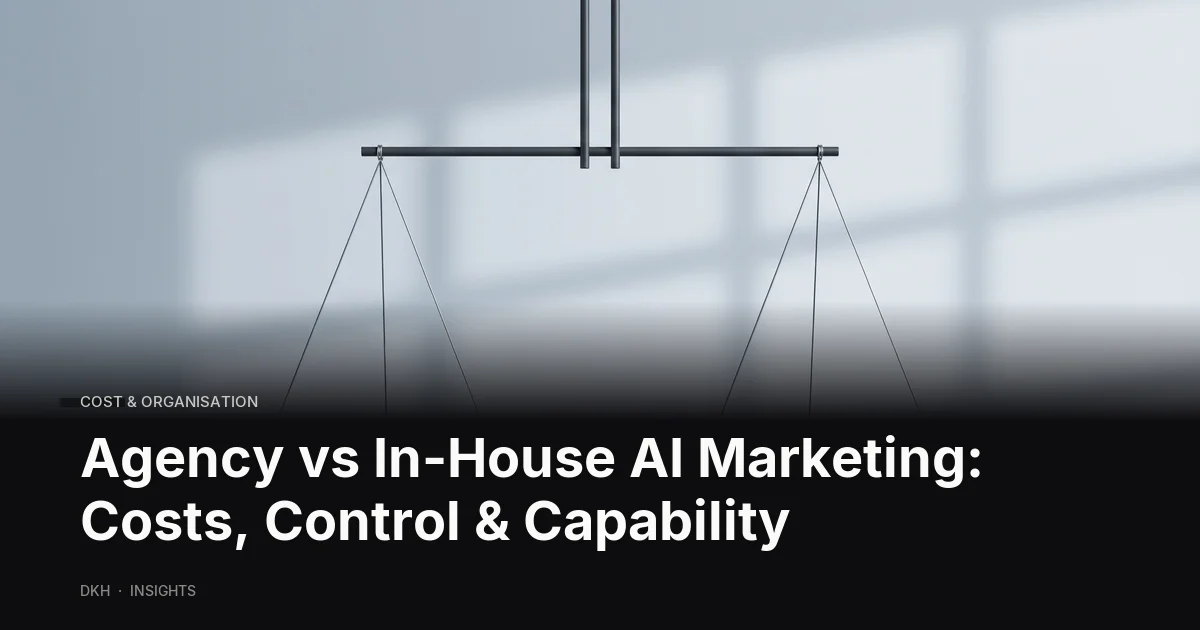
The old question of "hire an agency or hire in-house" used to be a straightforward calculation: agency monthly fee versus salary plus benefits. AI has rewritten both sides of that equation. Agency production costs are falling. The barrier to building your own team is falling too. One colleague who knows how to use AI can now produce what used to take several people. This article will not tell you which path is definitively right. It will break down the cost structure of both options so you can make the judgement with your own numbers.
The core of deciding between an agency and building your own AI marketing team is not monthly fee versus salary. It comes down to three things: cost structure (fixed or flexible), control (where brand judgement sits), and capability accumulation (where AI capability stays). For small teams, the sensible answer is often a hybrid model: keep core judgement in-house and outsource capacity.
TL;DR
- The true cost of an agency is the monthly fee plus the communication overhead. The true cost of building in-house is the salary plus the training period plus the risk of staff turnover.
- AI lowers the barrier to building in-house: a small team with AI workflows can match the output that used to require outsourcing.
- The biggest hidden difference is capability accumulation. With outsourcing, the experience stays with the agency. With an in-house build, it stays with your own company.
- The hybrid model is the realistic answer for most SMEs: keep strategy and brand in-house, outsource execution as needed.
What are the real costs of each path?
Agency costs look clear on the surface: a monthly retainer or a project fee. But the real cost includes two items that often stay off the books. The first is communication overhead, covering briefs going back and forth, rounds of revisions and waiting time. The second is context loss: an agency does not know your business the way your own people do. Every change of account manager means starting the education process again.
In-house costs work the other way round. Salaries and benefits are easy to count. The hidden costs are the training period, spending on tools and systems, and the risk of attrition. New people adapt to new ways of working, with limited output in the first few months. People you have trained may leave, and their capability leaves with them. The AI era adds one further consideration. If nobody on the team knows how to put AI into practice, in-house hiring adds headcount without adding capacity.
How has AI changed this figure?
In two directions.
First, capacity has decoupled from headcount. A small team that knows how to use AI agent workflows can produce the volume that used to require a much larger team. DKH itself is a six-person consultancy. Its output spans strategy, content, design and websites. For the specifics, see 6 people doing the work of a dozen: two versions of the agent workflow broken down. The old assumption that building in-house is always more expensive than outsourcing no longer necessarily holds.
Second, the criteria for choosing an agency have changed. An agency that has not adopted AI will become progressively less competitive on cost structure and output speed. When evaluating an agency, you must ask whether it runs its own operations with AI. For guidance on how to ask it, see How to choose an AI consultancy: seven questions.
Beyond money, what else should you be counting?
Control and capability accumulation.
The more you outsource brand voice, client relationships and strategic judgement, the thinner your company's understanding of its own business becomes. By contrast, the biggest return on building in-house is not the monthly fee saved. It is AI capability becoming a company asset. The team learns to break down workflows, write briefs and assess quality. These capabilities compound over time. They can also be applied across other parts of the business.
Building in-house is not without cost, however. You need someone willing to lead the effort. You need to invest training time and accept a learning curve in the first few months. Push ahead without these conditions and most efforts stall. See the five common reasons AI transformation fails for the typical failure patterns.
How does the hybrid model actually work?
The realistic answer for most SMEs is not either/or. It is drawing a clear line between what you keep in-house and what you outsource. A sensible split is to build strategy, brand judgement and high-frequency content in-house. These depend most on context and carry the highest communication cost when outsourced. Commission specialist execution such as large campaigns, video production and media buying on an as-needed basis.
The precondition for this path is that the internal team has basic AI capability. Without it, they cannot write a clear brief, let alone judge whether outsourced output meets the standard. The first step in a hybrid model is therefore often training, not hiring. For the training path, see the Marketing Team AI Training Guide 2027.
Next step: hand it to us. Free 15-minute consultation, leave your details on the contact page and we will WhatsApp you within one working day.
FAQ
FAQ
- How small does a company need to be before building in-house makes sense?
- It is not about headcount; it is about two things: whether marketing is the core engine of your business, and whether there is one person willing to lead the implementation. If both conditions are met, even a company of three to five people can justify building in-house. If neither is present, outsourcing is the right starting point regardless of company size.
- How many people do you need before an in-house team can get off the ground?
- In the AI era, possibly one or two of the right people plus one well-designed workflow is enough to start. The point is not headcount; it is whether that person knows how to break down processes for AI to handle, and whether the company is willing to give them a proper training period.
- Have agency fees gone up or down?
- The market is splitting sharply. Agencies that have adopted AI have improved their cost structures, giving them room to offer better pricing or faster turnaround. Those that have not remain on the old pricing and the old speed. An agency's AI maturity now directly affects whether what you pay represents good value.
- Moving from full outsourcing to a hybrid model, where do you start?
- Do not touch the agency contract yet. The first step is internal training, so the team can assess output quality and write clear briefs. Only then should you gradually bring the highest-frequency, most context-heavy workflows back in-house. Reverse the order and you create a vacuum, with neither side performing well.
KEEP READING
Keep reading
NEXT STEP